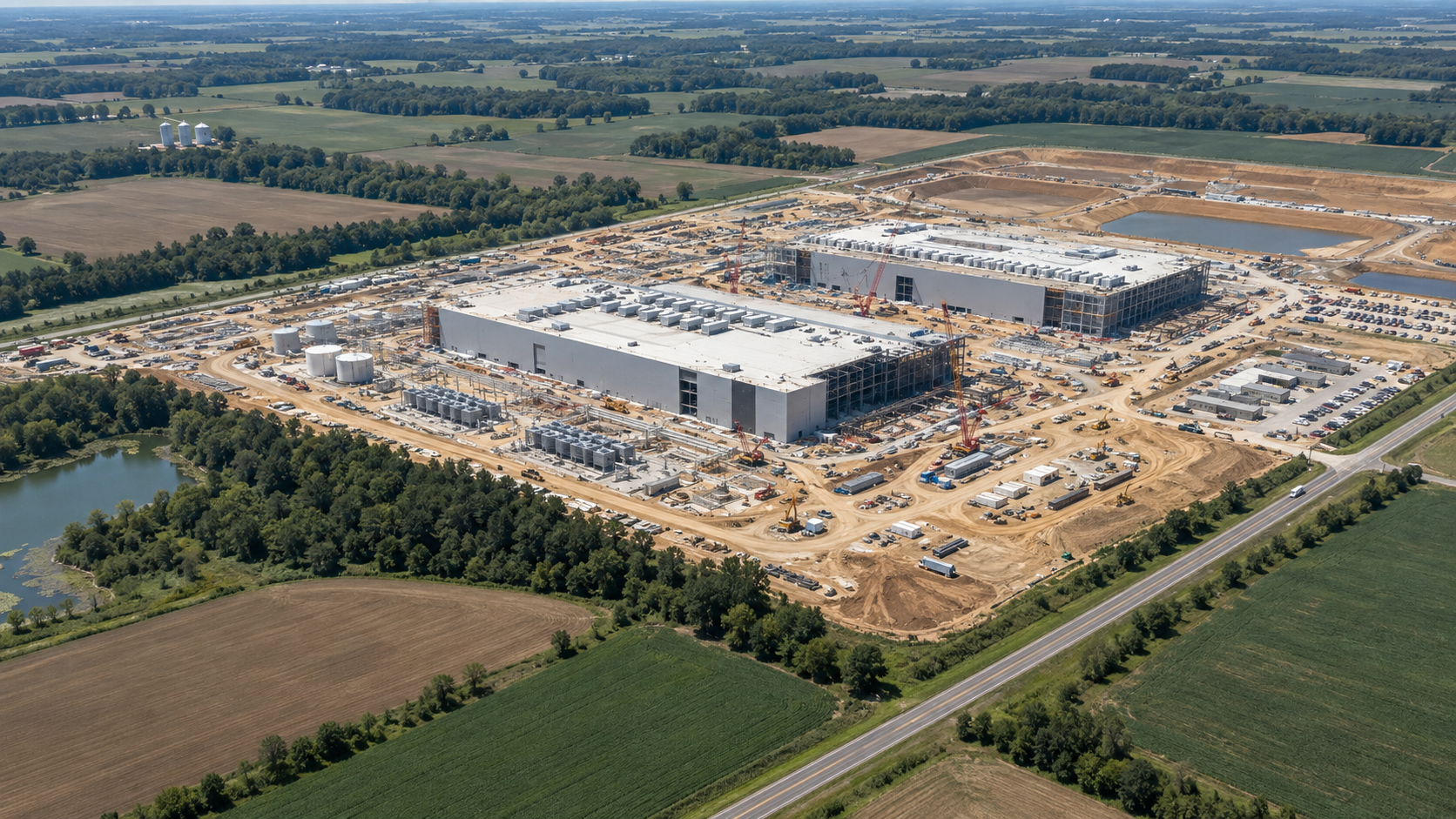
About a month ago, I came across a video that was going around titled “I’m done coding with AI,” by Brett from Brett Codes. He basically lays out a bunch of reasons why he decided to stop coding with AI, and a lot of what he said I actually agreed with. But his concern about data centers and water caught my attention because it was something I knew very little about.[^1]
That sent me down this rabbit hole and is ultimately why I am writing this article. I had heard water mentioned in arguments against data centers, but I had never actually looked into the numbers. Hopefully, I can bring some factual context to this so you don’t have to take someone’s word for it. That is what I wanted for myself. I heard a claim, realized I didn’t know enough to judge it, and wanted to get to the bottom of it.
First, I have to say that, in a weird way, I am deeply passionate about water. Clean water is something I don’t think we appreciate enough. And my concern is not limited to the water coming out of our taps. I care about the rivers, lakes, groundwater, and ecosystems that depend on them. A water source does not become irrelevant to me just because it is not connected to somebody’s kitchen sink.
The first number I found
One of the papers I came across was Making AI Less “Thirsty”: Uncovering and Addressing the Secret Water Footprint of AI Models, by Pengfei Li, Jianyi Yang, Mohammad A. Islam, and Shaolei Ren. First released in 2023, it estimated that training GPT-3 under the study’s modeled U.S. conditions could directly evaporate approximately 700,000 liters of freshwater. That is about 185,000 U.S. gallons.[^2]
This is an estimate based on assumptions about training energy and cooling efficiency, not an independently measured water bill for the actual training run. The paper says the specific training location was not public. It also concerns training, not inference, which is the work a model does when it answers a question. Both can have a water footprint, but they are different activities.[^2]
To get a sense of the volume, the EPA says the average American family uses more than 300 gallons a day at home. Using 300 gallons a day as an example, 185,000 gallons would cover about 1.7 years. That is a comparison of volume, not a claim that household water use and evaporation have the same consequences.[^3]
And yes, I asked a cloud based AI model to help me picture that amount of water, so I may have contributed to the very thing I was looking into.
This first number did not seem promising. But before gathering a crowd with pitchforks, I needed to understand the bigger picture. How many data centers are there? Do they all use water the same way? And how much water do they use altogether?
Not all data centers cool the same way
For starters, evaporative cooling is exactly what it sounds like. Water evaporates to carry heat away. But circulating water around computing equipment does not necessarily require evaporation. There is also a catch: a closed loop around the servers can still connect to another system that evaporates water outdoors. You have to look at the whole cooling arrangement.[^4]
Microsoft has announced designs intended to eliminate evaporation for cooling. That does not mean every existing facility, or even every newly opened one, already operates that way.[^5]
I couldn’t verify a reliable national percentage separating the different cooling methods. For the facility count, a Pew Research Center analysis identified approximately 3,100 operating U.S. data centers in an industry database as of February 19, 2026. That is a dated inventory, not a complete government census of every computing facility.[^6]
I also couldn’t verify a national annual water breakdown separating AI training, AI inference, and everything else data centers do. So I am not going to take a total for data centers and label every gallon “AI.”
How much water are we actually talking about?
Before the national numbers, there is a distinction I had to learn: water withdrawn is not the same as water consumed.
Withdrawal means taking water from a source. Consumption is the portion evaporated, released by plants, incorporated into products, or otherwise not immediately available for reuse. The water has not disappeared from the planet, but it is not necessarily back in the same local supply when it is needed. Irrigation water applied to a golf course is another measure. It does not tell us how much ultimately evaporates, drains away, or returns underground.[^7]
The 2024 United States Data Center Energy Usage Report, from Lawrence Berkeley National Laboratory, estimates that U.S. data centers directly consumed 66 billion liters in 2023, or approximately 17.4 billion gallons. That is a modeled estimate covering AI and other computing, not a measurement of AI alone.[^8]
A 2026 academic preprint called Small Bottle, Big Pipe estimates 19.4 to 22.6 billion gallons of direct consumption and 24.8 to 29.0 billion gallons of withdrawals in 2024. Those are its main modeling cases, focused on hyperscale and colocation facilities, meaning large cloud facilities and facilities that rent capacity to other businesses. They assume zero water use for the remaining data-center category. These are scenario estimates, not an audited total or a statistical confidence interval.[^9]
There is another number I cannot leave out just because it makes the argument less convenient. Berkeley Lab separately estimates roughly 211 billion gallons of water consumption associated with generating data centers’ electricity in 2023. That includes reservoir evaporation attributed to hydropower. It is not water flowing through the data centers themselves, but it matters to a broader freshwater discussion.[^8]
So the comparison below concerns direct facility water, not the complete water footprint of either industry. Comparing complete footprints would also require golf’s upstream water use. I don’t have a matching estimate for that, and I am not going to quietly count it for one side and ignore it for the other.
Well, let me tell you about golf courses
The 2024 Golf Course Environmental Profile survey estimates that U.S. golf courses applied approximately 532 billion gallons of irrigation water that year. This comes from an industry survey extrapolated nationally, not a government census or an independent audit of every course.[^10]
Compared with the newer data-center withdrawal estimate, that is roughly 18 to 21 times as much water applied to golf courses as withdrawn by the facilities covered in those modeling cases. That is my calculation from the two estimates. It is not a finding that golf consumes 18 to 21 times as much freshwater or causes 18 to 21 times as much environmental damage.[^9][^10]
Even with those qualifications, the difference in annual volume caught me off guard. Personally, I think 532 billion gallons is an enormous amount of irrigation for such a boring excuse for a sport. You are welcome to disagree about golf. That part is my opinion.
But there is an objection to this comparison that needs addressing. Only about 9% of golf’s irrigation falls into the survey’s municipal category. Its source breakdown puts a majority in wells, lakes, and ponds, and about one-fifth in recycled water. Other sources include rivers, streams, creeks, and canals. These are approximate survey shares, not a water-quality analysis.[^10]
The authors of Small Bottle, Big Pipe warn that golf comparisons can obscure the particular demands data centers place on public water systems. That is a fair warning when discussing treatment plants, pipes, and peak supply capacity.[^9]
But that is not the whole question I am asking.
My concern is freshwater and the environment, not just municipal water. “It didn’t come through the city’s pipes” does not answer that concern. Freshwater is not the same thing as treated drinking water, and a well or lake can supply freshwater without supplying water that is safe to drink untreated.[^7]
The U.S. Geological Survey explains that groundwater pumping can reduce water in streams and lakes and lower water levels that wetlands and vegetation depend on. Excessive pumping can damage habitat. Whether a particular withdrawal does that depends on the local conditions and how the water system responds.[^12]
Imagine a town and a golf course drawing from the same aquifer. The town sends its water through a treatment plant. The course pumps its water directly into irrigation. The second pump has bypassed the treatment plant, not the aquifer.
That is why I think the comparison absolutely belongs in a conversation about freshwater. It still has to be an honest comparison. A source label does not prove that every gallon is freshwater, that every pond is a drinking-water supply, or that every course is depleting its watershed. But the municipal share does not establish the opposite, either.
What about recycled water?
Recycled or reclaimed water commonly means wastewater that has been treated and supplied for another use. The EPA documents its use for golf irrigation. It does not mean a course somehow captures every gallon it sprays and keeps using that same water forever.[^13]
Using treated wastewater instead of making additional freshwater withdrawals can be a real improvement. It should not be dismissed as a marketing trick just because a golf course benefits from it. But I also would not count every gallon of reused water as another new withdrawal from a river or aquifer.[^13]
There can still be an environmental question about where that water would otherwise have gone. EPA guidance explains that some rivers depend on treated wastewater discharges to maintain flow and habitat. Diverting that water for reuse can reduce those flows. The effect depends on what the reuse replaces and what happens downstream.[^14]
So I am not arguing that recycled water is pointless. I am arguing that neither “recycled” nor “not municipal” means we can stop asking environmental questions.
And fair is fair: the golf survey reports an estimated 31% reduction in national irrigation volume between 2005 and 2024. Its authors discuss regulation, public scrutiny, and changes in course management. I cannot honestly say that nobody has questioned golf’s water use or that nothing has been done about it.[^11]
Where this leaves me
I went into this expecting a scary number to give me a fairly straightforward answer. Instead, I found that the answer depends on what the number measures and what conclusion you are trying to draw from it.
I still think golf is a worthwhile comparison. It gives me context for the scale of direct water demand and raises a question about what we consider an acceptable use of water. The fact that much of golf’s supply comes from outside municipal systems does not remove it from a freshwater discussion.
What I cannot honestly say is that golf’s larger irrigation total proves every data center is harmless. If a project threatens a community’s water supply or an ecosystem, pointing to a golf course somewhere else does not fix that. Someone can oppose a water-intensive data center without claiming it uses more water than golf nationally.
I also cannot promise that total data-center demand will fall just because cooling technology improves. Lower use per facility can be outweighed by growth. Berkeley Lab’s 2024 report projects increasing direct water consumption through 2028.[^8]
So no, my conclusion is not that water should be removed from every argument against data centers. It is that the argument needs to go further than a national number that sounds frightening. I want to know how much a project takes, how much returns, what source it uses, and what that leaves for the people and ecosystems around it.
And I want the same questions asked when the water is keeping a golf course green.
I don’t have to enjoy golf to acknowledge improvements in how it uses water. Someone else doesn’t have to like AI to acknowledge that a national total is not enough to establish a local disaster. But if we are going to argue about freshwater with this much passion, I want the concern to extend beyond whether we like the thing using it.
References
[^1]: Brett Codes, “I’m done using AI”, August 10, 2026. The companion essay links the video and discusses water. The article paraphrases the concern rather than claiming to reproduce an independently verified exact spoken quotation.
[^2]: Pengfei Li, Jianyi Yang, Mohammad A. Islam, and Shaolei Ren, Making AI Less “Thirsty”: Uncovering and Addressing the Secret Water Footprint of AI Models. First submitted April 6, 2023; version 5 revised March 26, 2025. See Section 3.3.1 for training assumptions and the statement that the specific training location was not public. The article reports the researchers’ estimate, not an independently verified actual training volume. Conversion: 700,000 liters ÷ 3.785411784 = approximately 184,920 U.S. gallons.
[^3]: U.S. Environmental Protection Agency, How We Use Water. EPA says the average American family uses more than 300 gallons daily at home. Illustration: 184,920 ÷ 300 ÷ 365 = approximately 1.69 years. This compares volumes, not consumptive effects.
[^4]: U.S. Department of Energy, Cooling Water Efficiency Opportunities for Federal Data Centers, particularly the typical cooling-system description and direct liquid cooling section. Separate circulating loops can ultimately transfer heat to an evaporative cooling tower.
[^5]: Microsoft, Sustainable by design: Next-generation datacenters consume zero water for cooling, December 9, 2024. This is evidence of the announced design, not independent verification of every facility’s performance or industry-wide adoption.
[^6]: Pew Research Center, Most new data centers in the U.S. are coming to rural areas, April 13, 2026. Data Center Map snapshot dated February 19, 2026. Published regional operating counts sum to 3,068.
[^7]: U.S. Geological Survey, Water-Use Terminology. See consumptive use, freshwater, irrigation water use, self-supplied water use, and water withdrawal. A source category does not independently determine salinity, potable quality, or ecological impact.
[^8]: Lawrence Berkeley National Laboratory, 2024 United States Data Center Energy Usage Report, printed pages 55 to 58. Direct consumption: 66 billion liters in 2023, approximately 17.435 billion gallons. Electricity-related consumption: nearly 800 billion liters, approximately 211 billion gallons. The latter uses regional electricity mixes and includes hydropower reservoir evaporation; it is an attributed footprint, not a direct measurement of marginal water loss caused by each data center. The report also presents modeled increases through 2028.
[^9]: Yuelin Han, Pengfei Li, Adam Wierman, and Shaolei Ren, Small Bottle, Big Pipe: Quantifying and Addressing the Impact of Data Centers on Public Water Systems, 2026 preprint, version 2. See Tables 9 and 10 on printed page 40, Appendix A, Section 3.3, and Appendix I. Main 2024 cases give 19.351 to 22.618 billion gallons consumed and 24.795 to 28.993 billion withdrawn. Their “other” category contributes zero in those cases by assumption, not by proof of zero actual use. The numerical range is not a confidence interval. The public-system comparison warning concerns more than annual gallons, including supply types and peak capacity.
[^10]: Golf Course Superintendents Association of America, Golf Course Environmental Profile, Phase IV water report. See Figure 2, Figure 5 on printed page 7, and Table 12 on printed page 62. National irrigation estimate: 1,631,915 acre-feet × 325,851.428571 gallons per acre-foot = approximately 531.762 billion gallons. Dividing by 28.993 and 24.795 billion gives approximately 18.34 and 21.45. Source shares are approximate; rounded percentages and separately projected source totals do not reconcile exactly with the national total. They are not a certified freshwater-only accounting. The national estimate is survey based.
[^11]: J. Bryan Unruh, Travis W. Shaddox, and colleagues, From acre-feet to outcomes: Interpreting the 2024 GCEP Water Survey. Companion discussion of the national irrigation trend and management context. The 31% change is an estimated national reduction, not proof that each course improved by that amount or that efficiency alone caused the decline.
[^12]: U.S. Geological Survey, Groundwater Decline and Depletion, particularly the discussion of effects on streams, lakes, wetlands, and vegetation. These are hydrological mechanisms, not proof of damage at every golf course or data center.
[^13]: U.S. Environmental Protection Agency, Basic Information about Water Reuse. Includes wastewater reuse for golf irrigation and the potential to reduce demands on other water supplies.
[^14]: U.S. Environmental Protection Agency and partners, Navigating the NPDES Permitting Process for Water Reuse Projects, March 2022, printed page 11, “Maintaining or Enhancing Receiving Water Flows.” Some receiving waters depend on treated effluent; diverting that flow to reuse can affect downstream habitat.